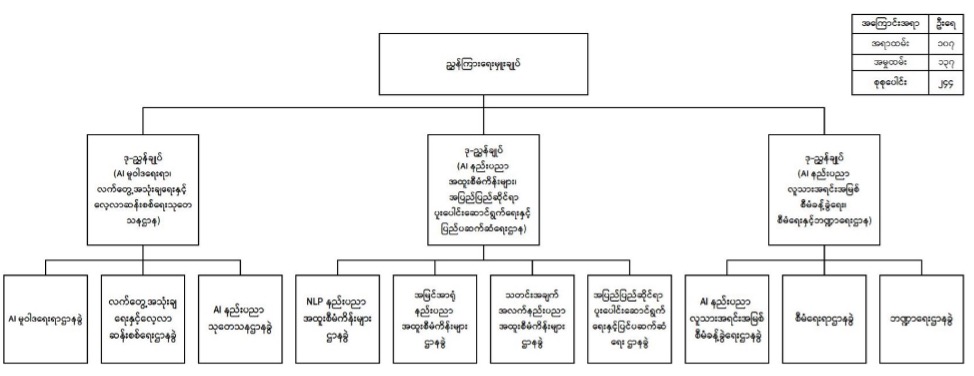
National Artificial Intelligence Technology Development Department
Background
Machines can now learn and understand in ways similar to humans. Machines capable of continuous learning may acquire intelligence surpassing that of humans. If AI can not only imitate human intelligence but become many times more intelligent, those who possess it could become immensely powerful, like a deity. AI is therefore described as a king among technologies, capable of influencing all others. Acquiring AI is a national undertaking of vital importance to development across all sectors. As those who lead AI may dominate the world in the future, governments worldwide are urgently implementing AI in national-level activities.
As AI capabilities advance rapidly, its threats also grow. Since AI threats must be countered and defended against using AI, developing indigenous AI is a national responsibility for all Myanmar citizens. In pursuing this responsibility, the National Artificial Intelligence Technology Development Department must define and implement its objectives, policies, responsibilities and capabilities.
The Myanmar Language Development Project was implemented to digitise Myanmar language and literature with AI and use natural language processing (NLP) to enable Myanmar to stand alongside other languages in cyberspace. It was approved by State Administration Council Office Letter No. 716 (1283)/14/Council Office dated 1 November 2023.
The AI-based Myanmar Language Development Project began its first phase in February 2024. The source records a total of 58 members from five ministries: 28 from Defence, three from Foreign Affairs, four from Information, seven from Education and 12 from Science and Technology. It implemented three components:
1. Automatic Speech Recognition (ASR).
2. Text-to-Speech (TTS).
3. Machine Translation (MT).
Following the Head of State’s guidance, work to apply AI to CCTV networks began at the Nay Pyi Taw Council CCTV Control Center in November 2023. The Computer Vision Development Project commenced in January 2025 in cooperation with the Ministry of Home Affairs.
To modernise agriculture, Myanmar’s principal economic sector, through digital systems, the Ministry of Agriculture, Livestock and Irrigation began developing an AI-based mobile application named “Taung Thu Gyi AI” on 18 January 2025.
The Supervisory Committee for Disseminating Legal Knowledge through AI was established on 21 March 2025 by State Administration Council Notification No. 51/2025. The Committee for Disseminating Legal Knowledge through AI was subsequently formed and began work on 7 April 2025.
On 4 April 2025, the Computer Vision Development Project, Myanmar Language Development Project and future AI-based projects were placed under Ministry No. 4 of the Office of the Chairman of the State Administration Council, to implement them at Union level and accelerate their work. The project was renamed the National Artificial Intelligence Technology Development Project. With approval from Union Government Meeting No. 3/2025 held on 1 August 2025, it was established as the National Artificial Intelligence Technology Development Department with 244 posts: 107 officers and 137 staff.
Policy
1. Ensure the continuous development of AI across Myanmar’s sectors.
2. Use technology to add value across national sectors and strengthen national security.
3. Reduce national expenditure and achieve full technological sovereignty by creating indigenous technology.
4. Build technological capabilities to seize opportunities arising from shifts in global power and production chains.
5. Prevent the loss of Myanmar’s technical and professional talent and continuously develop Myanmar AI specialists.
Goals
1. Implement nationally important AI projects for national and state security under uniform nationwide standards, strategies and policies. Develop AI projects and applications required by the state and ministries.
2. Create indigenous AI at national level and achieve full technological sovereignty through that capability.
3. Support the country through future AI Government and AI Governance systems.
4. Enable long-term maintenance and independent upgrades of architectures, logic and models developed with indigenous technology, significantly reducing national costs.
5. Collect and retain data as national data.
6. Continuously train AI human resources.
7. Build Myanmar large language models.
Objectives
1. Enable widespread use of AI across sectors at Union level.
2. Implement nationally important AI projects for national and state security.
3. Support and advise the state through AI policies, common nationwide standards and guidelines, and continuous analysis of AI.
4. Lead the continued expansion of AI research, develop a new generation of specialists for national sectors, and incorporate AI into basic and university education.
5. Facilitate effective domestic and international cooperation for Myanmar’s AI development and raise public awareness of AI.
6. Provide support and oversight for AI use across political, economic, social and other national sectors.
7. Retain state-trained AI specialists through departmental appointments, participation in special projects and employment opportunities linked to industry. Apply their skills for national benefit and establish an AI institute that serves Myanmar society, continuously develops AI specialists and researchers, and enables cross-sector collaboration.
8. Establish AI Government and AI Governance that enable government departments and the public to use AI safely, and systematically coordinate its development, use and management for the interests and security of the state, government and citizens.
9. Build an AI data centre for national-level AI use and progress towards AI Governance. Lead relevant ministries through digitisation, digitalisation, digital transformation and socio-digital transformation as foundations for AI.
Responsibilities
1. Develop policies, intellectual property provisions, ethics, standards and regulations concerning international AI and AI human resource development.
2. Create AI services and products, transfer technology, attract investment, monitor AI applications, assess special projects and current AI advances and impacts, and undertake research and innovation.
3. Cooperate on projects, AI ethics, intellectual property, standards, regulations, laws, policies, research, innovation and development.
(d) Coordinate with government, the armed forces, private organisations and technology companies on AI development, safe use and countering AI-enabled attacks.
4. Develop NLP software, medical AI software and sector-specific computer vision AI software to protect national security and national interests.
5. Supervise Triple Helix cooperation between government, industry and universities in AI.
6. Establish an AI institute that serves Myanmar society and trains AI human resources in accordance with departmental policies; establish associations for Myanmar AI professionals and enthusiasts.
7. Manage departmental personnel, finance, management and administration.