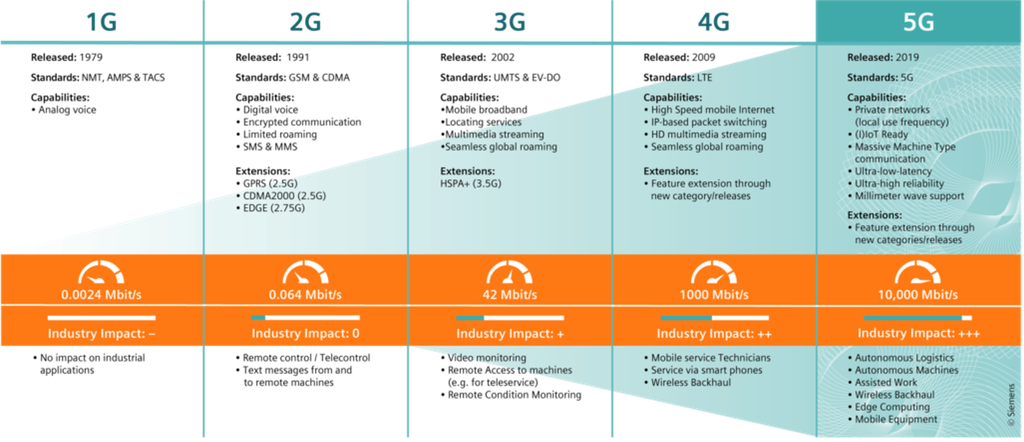
5G is the fifth generation of mobile networks, following 1G, 2G, 3G and 4G. It is the latest cellular technology described in this article, designed to improve internet speeds and responsiveness in global wireless communications.
Widespread 5G use can bring very high speeds, lower transfer delays and more consistent connectivity. These capabilities can benefit businesses using mobile data, transport and communications, healthcare, agriculture, livestock and logistics.
How Does 5G Work?
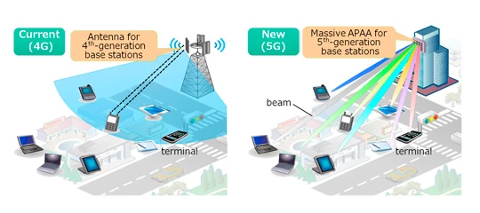
Fourth-generation Long-Term Evolution (LTE) provides a foundation for 5G. Advanced network architectures and the global 5G New Radio air-interface standard introduce capabilities beyond 4G. New antennas use multiple-input/multiple-output (MIMO) technology. 5G employs massive MIMO, with tens or hundreds of antennas rather than the two to five described for ordinary MIMO, enabling much higher data rates.
Objectives of 5G
Under the IMT-2020 performance targets:
Data rate: peak rates of up to 20 Gbps and average user-experienced rates of 100 Mbps.
Connection density: approximately one million devices per square kilometre.
Mobility and latency: support for speeds up to 500 km/h, including high-speed rail and drones; end-to-end network latency below 10 ms and air-interface latency below 1 ms.
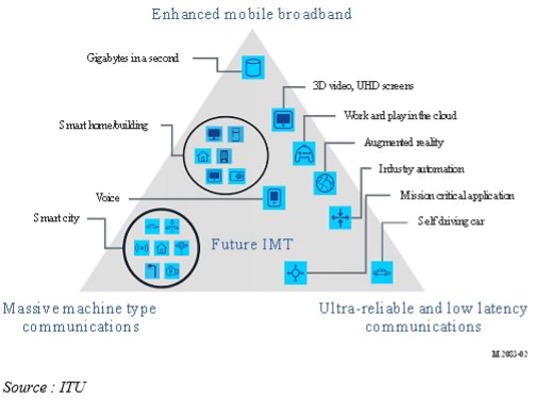
Organisations such as 3GPP work to meet IMT-2020 requirements through three usage scenarios: enhanced mobile broadband (eMBB), massive machine-type communications (mMTC), and ultra-reliable low-latency communications (URLLC).
5G advances radio-frequency technology used in wireless and satellite communications. Beyond downloading an HD film to a phone in seconds, it can connect things in many different locations.
Spectrum for 5G
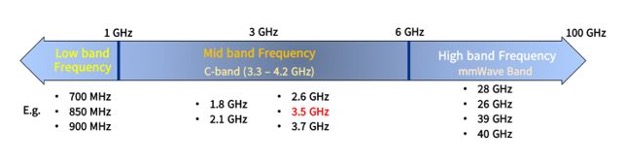
Spectrum bands vary according to the requirements of eMBB, URLLC and mMTC services.
Low band, generally below 1 GHz, provides broad coverage suitable for urban, suburban and rural 5G and IoT services, with strong penetration into buildings.
Mid band offers more spectrum resources and channel bandwidth than low band and wider coverage than high band. Its balance of coverage and capacity makes it important for initial 5G deployments. In particular, C-band around 3.5 GHz is a key prospective band in Asia.
High band offers more spectrum resources than low and mid bands, but its higher frequencies limit coverage. Its large capacity makes it suitable for short-range hotspots and ultra-high-speed services requiring low latency.
The article describes 3GPP Release 15 frequency ranges as FR1, 450–7,125 MHz, also called sub-6 GHz, and FR2, 24–52 GHz, also called millimetre-wave or high band.
Lower-frequency sub-6 GHz signals travel farther and penetrate walls and obstacles, supporting 5G coverage.
Millimetre waves, described here as 30–300 GHz, operate at very high frequencies and enable gigabit-per-second speeds.
5G Opportunities
Fast connectivity enables providers to support many applications and locations. From smartphones to smart factories, 5G is an open platform for innovation towards a smarter, safer and more sustainable future.
Myanmar is among the countries working towards 5G adoption. Compared with 4G, it offers more advanced capabilities, higher speeds and greater responsiveness.
Users can access new functions and services and experience fibre-like speeds on their mobile handsets.
However, the article identifies a lack of domestic use cases offering substantial benefits, high handset prices, large investment requirements, long payback periods and other technical requirements that must be addressed before deployment in Myanmar.
Sources: Internet; 5G by Ericsson; “What Is 5G?” by Rosie S.