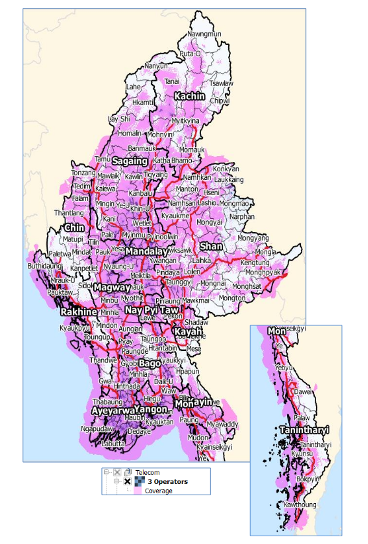
Universal service means supporting telecommunications access for nearly everyone in Myanmar, regardless of location. In underserved areas, the Universal Service Fund (USF) helps finance infrastructure such as towers, radio stations and fibre cables. Telecommunications is essential to socioeconomic life and development, supporting education, health, information, entertainment, knowledge and weather services. Governments worldwide therefore give particular attention to developing the sector.
Mobile operators and internet service providers must assess investment returns, which can prevent them from serving remote areas where commercial returns are insufficient. Such places experience gaps in connectivity, internet access and digital skills, delaying development. Expanding infrastructure, providing affordable internet and teaching technical skills can reduce this digital divide. Many governments have established universal service funds for that purpose.
In Myanmar, the ministry established and supervises a USF under section 54 of the Telecommunications Law to extend infrastructure in underserved areas and implement programmes that broaden and improve services. The four mobile operators contribute 2% of annual relevant revenue after completing four years of their licence terms. The fund supports communications in remote areas with limited economic and telecommunications development. Regulations on establishing and supervising the USF have also been issued.
A five-member supervisory body oversees the fund. It is chaired by the Deputy Minister for Transport and Communications and includes the PTD Director General, a rotating representative of telecommunications operators, a Consumer Affairs Department representative and a Budget Department representative.
The Universal Service Strategy for Myanmar (2019–2023) was issued to guide implementation. After its term ended in December 2023, approval from the State Administration Council Office extended it as the Universal Service Strategy for Myanmar (2024–2026) through December 2026. Drawing on international experience, it aims to give nearly everyone access to communications, using USF support for remote and underserved communities, people with disabilities, people in poverty and areas the four operators cannot serve on a commercial basis.
The fund pursues four objectives:
1.Accessibility — enable all residents to access services.
2.Availability — provide basic connectivity regardless of location.
3.Ability — improve the public’s capacity to use IT services.
4.Affordability — make prices accessible to all income groups.
The strategy provides three programmes:
Programme 1: Mobile coverage for unconnected residents of remote and underserved areas, as well as highways and major roads.
Programme 2: High-speed internet for nearly everyone, including educational and social institutions, to develop digital skills.
Programme 3: Inclusive projects, including support for different languages and people with disabilities, so that basic communications and internet are available regardless of location, income, gender or disability.
Tenders for USF-supported mobile infrastructure in underserved areas covered 32 townships in 2020, 22 townships in 2022 and nine locations in 2023. Although bids were awarded, COVID-19 and instability in border areas prevented implementation. In fiscal year 2024–2025, two locations where work was feasible were selected: Lel Ma village in Lewe Township, Nay Pyi Taw Council Territory, and Done Nyaung Hmaing village in Kyunsu Township, Tanintharyi Region. Site surveys were conducted for the rural telecommunications infrastructure project before the four operators were invited to tender on 11 December 2024. Ooredoo Myanmar Limited won the Lel Ma tender and MPT won the Done Nyaung Hmaing tender. Implementation will proceed following contracts with the two operators. Further services for underserved areas are planned for fiscal year 2025–2026.
Using the USF to expand mobile towers in remote, economically and digitally underserved areas and to enable access regardless of location, income, gender or disability can improve the socioeconomic lives of ethnic communities nationwide and support other sectors.
References
Regulations Establishing the Universal Service Fund
Universal Service Strategy for Myanmar
https://raceias.com/current-affairs/universal-service-obligation-fund-usof
Aung Pyae (PTD)